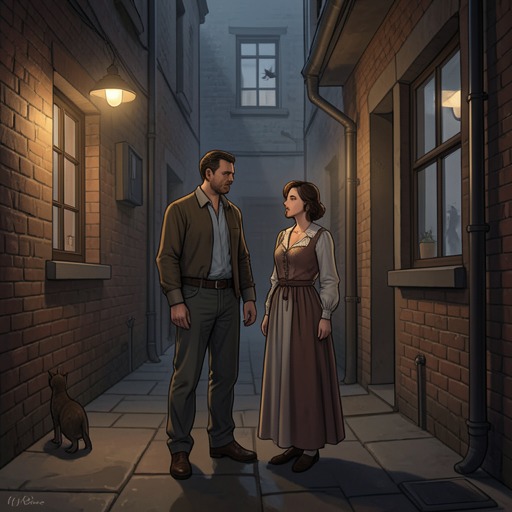
Toru Okada meets May Kasahara
The Wind-Up Bird ChronicleToru Okada meets May Kasahara while searching for his missing cat, and the encounter grows from a chance conversation across an alley into an enduring, unconventional connection. May’s offer to help him look for the cat leads him into the neighboring garden and, eventually, to the abandoned well on the Miyawaki property. Their first meeting thus joins an ordinary search to the book’s strange, recurring landscape of absence, curiosity, and descent.
A Chance Meeting During the Cat Search
Toru is standing by a chain-link fence, looking into a garden that seems suited to cats but holds none. A pigeon cries from a television antenna, and the shadow of a stone bird breaks across the undergrowth. As he lingers, May calls to him from the opposite side of the alley. She is a small girl with a ponytail, amber-framed sunglasses, and a light-blue sleeveless shirt; one hand is in her pocket, the other resting on a low bamboo gate. Their separation is only a few feet, but the crossing between them begins as a mildly absurd exchange about the heat.
When May asks whether he lives nearby, Toru tries to point toward his house and realizes that the route he took has left him unsure which way it is. He explains that his large, brown-striped cat, whose tail tip bends slightly, has been gone for a week and was reportedly seen in the neighborhood. The details make the meeting part of a concrete search rather than a planned introduction: May enters Toru’s life because the cat has disappeared and because he has come looking for it.
May proposes that he wait in her yard. Cats pass through her property on their way to the Miyawakis’, she says, and someone might call the police if Toru continues hanging around outside. She assures him that she is alone and will help watch for the animal, adding that she has excellent eyesight. Toru considers the practicalities of his afternoon, then follows her through the gate and across the lawn. The search has not yet found the cat, but it has given him a reason to enter a place that will acquire a significance beyond the immediate errand.
From Waiting to the Well
A later meeting at the same yard resumes their acquaintance in a new situation. Toru is sitting quietly with his eyes closed when May calls to him; the gate stands wide open, and she has come inside. She is wearing the same light-blue Adidas shirt and short pants, walks with a slight limp, and has removed her sunglasses. The scene repeats the intimacy of the earlier garden encounter while shifting its balance: May is no longer a stranger across the alley, but someone who can appear at Toru’s side and address him directly.
In conversation, May asks Toru’s name and repeats it to herself, judging it unremarkable. She also says that she does not care whether he is gay, a pervert, or anything else. Her bluntness establishes the teasing, unceremonious mode in which the two speak; she declines to make social respectability a condition of their acquaintance. The narrative’s central label for Toru’s role in her life, Mr. Wind-Up Bird, also emerges from this relationship, turning his identity into a private form of address.
May later reflects on the difference between curiosity and courage after Toru describes how curiosity can draw someone into another person’s backyard. Curiosity, in his account, may spark action but can disappear, while courage has to last. May listens, stands, brushes dirt from her shorts, and asks whether he would like to see the well. Her invitation converts their exchange from talk about entering forbidden or unfamiliar places into a specific act of looking at one.
The well lies beside the house, under a round wooden cover held down by two concrete blocks. Its curb rises about three feet above the ground, and an old fruit tree stands nearby. The structure is roughly four and a half feet across and appears older than the house and surrounding objects; its concrete coating and antique wooden cap suggest successive efforts to reinforce or close something that belongs to an earlier age. May’s casual invitation therefore opens onto a place whose physical age and abandonment exceed the immediate scene.
A Relationship of Curiosity and Work
The meeting establishes an asymmetry that remains productive: May is younger, more direct, and willing to draw Toru toward experiences he has not sought out, while he answers her questions and follows her invitations without claiming to understand where they will lead. Their connection does not begin with a declared purpose. It develops through repeated conversations, teasing, and small acts of accompaniment, with May’s curiosity repeatedly turning an ordinary setting into a threshold.
That pattern later becomes practical. When Toru says he is unsure whether he is ready to work and needs time to think, May suggests that he join her at the wig company for a day. The work is not well paid, she says, but it is easy and allows him to choose his hours; a change of pace might help him work out what he needs. Toru accepts that she has a point, and May promises to collect him the next time she goes. The proposal extends the original offer to wait together: she does not solve his uncertainty, but gives him a concrete way to move through it.
Significance of the Encounter
The first meeting links three strands that will continue to matter: the absent cat that brings Toru into the neighborhood, May’s companionship, and the well that draws him toward the novel’s deeper spaces. The cat remains out of sight in the opening encounter; instead of resolving the search, May’s presence redirects it into a relationship and a landscape. The displacement is consequential: what begins as looking for a missing animal becomes a route into conversation, work, and repeated attention to the old well.
The scene also gives curiosity a double force. It is playful and social in May’s approach, but it is not merely a passing appetite for novelty: it carries Toru from the alley into the yard and from the yard to the well. His distinction between curiosity and courage anticipates the persistence demanded by the search and by the more difficult experiences that follow. May’s invitation does not explain the well or turn it into a simple symbol; the old, capped structure remains materially present, at once an abandoned feature of the property and a place toward which their conversation has led them.